

THE ART OF YACHT BRANDING
AI, DIY or Professional Designer?
Finding the Right Way to Create Your Yacht Logo
I did the test a year ago and promised to do it again.
The close bond between an owner and their yacht is often reflected in its name – and, just as importantly, in the way that name is presented on the hull.
A simple “Carpe Diem”, applied in standard Letraset lettering without any particular design, might suggest a rather understated relationship between owner and boat.
Others, particularly passionate or more extroverted sailors, place greater importance on having a distinctive, individually designed yacht name displayed proudly on the bow – something that can also be carried with pride on crew clothing and merchandise.
There are three common ways to create your own yacht logo: DIY, AI or working with a professional designer.
We put AI and professional yacht branding – in this case, my own work – to the test.
A REAL-WORLD TEST
I am specialise in yacht branding and have received international design awards. Before setting out to sea, I spent many years as Creative Director at advertising and design agencies.
But perhaps most importantly, I have been sailing around the world for the past six years, creating bespoke yacht logos along the way.
My clients range from owners of 35-foot monohulls to superyachts – covering just about every kind of vessel that floats.
Together with the crew of Ribes, I conducted a practical comparison: a competition between four different AI applications* and a professional designer.
Five specific criteria were established for the logo, which also had to be suitable for merchandising. Two rounds of revisions were included in the process.
The final result had to be delivered digitally in at least three different file formats to ensure it could be used for a variety of applications.
Please create a unique logo for the sailing yacht Ribes.
The owners‘ favourite colour is red. The most important task is uniqueness and strong impression. Readibility is not important. The owner: „it’s just for us“. One additional colour may be incorporated into the design.
The yacht is a monohull and the forth vessel to bear the name Ribes.
The logo should be clean, bold, distinctive and strong. It should also be versatile and adaptable to different applications and sizes.
Please provide the final logo in the following file formats: .jpg, .eps, .png and .svg, so that I can further edit and use the design as needed.
The logo will be displayed both on the stern and on the bow of the yacht, so it should be clearly recognisable and visually striking from a distance.


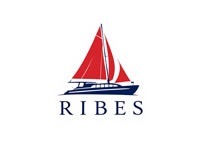
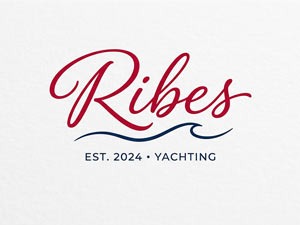

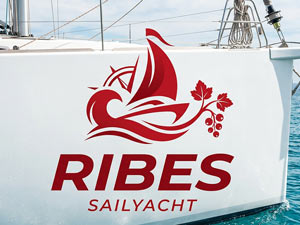
None of these logos comes even remotely close to meeting the requirements.
The fact that this is the third yacht named Ribes (Ribes III) has not been taken into consideration at all. The colour choice is generic and uninspired. None of the designs is truly unique, and none of the required production file formats has been provided.
Including a sail in the logo is completely unnecessary, as the logo will be displayed directly on the yacht itself.
None of the designs is clean, bold or strong in its appearance. Overall, the concepts fail to capture the distinctive identity and character that the logo for Ribes III should convey.
I would therefore ask you to reconsider the brief carefully and come up with a genuinely original, sophisticated and powerful design that meets the requirements.


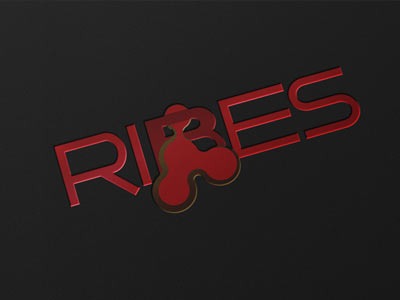
The logo is defined by a clear typography. The number four is symbolized by four interconnected circles. The four is variable and can change both in size and along the vertical axis. To create a unique color combination, I added red, sand, and beige tones. This results in a harmonious image. Naturally, the logo will be tested on the hull as well as on the crew wear.
THE RESULTS
1. QUALITY & CREATIVE PROCESS
The AI approach
AI delivered results almost immediately – several days faster than the designer.
There were no questions, no briefing and no real creative development process. Any requested changes had to be described in very specific terms.
Overall, the results lacked creativity and only superficially reflected the owner’s wishes.
Not a single design produced during the test met the specific requirements of the maritime environment.
Legibility, the effects of UV exposure on colours and the practical requirements of applying the logo to a yacht were not taken into consideration.
Although the logos were delivered digitally, no application examples were provided. Obtaining professional EPS files or properly vectorised artwork proved extremely difficult, if not impossible.
The professional designer approach
My process started with an initial briefing, followed by a more in-depth conversation about the owner’s preferences, ideas and expectations.
Only after this exchange did I present the first concepts, three to four days later, for discussion and refinement.
With almost all my clients, logo development is an evolving process. Quite often, owners only discover their true preferences as the creative process unfolds. It is a dialogue.
From an initial selection of seven designs, one favourite was chosen and developed further through several stages until the final result was achieved.
Once completed, the logo was supplied in all standard digital formats, together with a style guide illustrating the colours, typography and possible applications.
What does the logo look like on the hull? How does it work on a cap or a T-shirt?
The style guide provides the owner with a valuable reference for future use.
The specific requirements of the maritime environment were also taken into account – something that can be overlooked even by designers who do not specialise in yacht branding.
2. COST
AI solutions are considerably cheaper, although they are not necessarily free.
The free versions are generally insufficient for a process requiring professional results and specific file formats.
A subscription is usually necessary, and prices vary considerably depending on the application and its capabilities.
Monthly subscriptions range from approximately €9 to €249.
Even at the higher end, this is still less expensive than hiring a professional designer.
THE VERDICT
AI is fast and inexpensive, but it does not deliver a truly individual solution or consistent professional quality.
The results are often generic, the available file formats are limited, and there is no ongoing support when future requirements arise.
A professional designer requires more time and comes at a significantly higher cost.
In return, however, the quality is substantially better. Individual requirements are taken into account, all necessary file formats are provided, and the owner has someone to turn to for future adaptations, questions or additional design work.
When you consider the lifespan of a yacht logo, its many possible applications and the potential costs of having to redo or adapt the artwork later – not to mention the original investment in the yacht itself – the additional cost of professional design quickly becomes relative.
After all, owner satisfaction is priceless.
AI applications tested: Midjourney, Adobe Firefly, OpenAI and Mistral AI.